
The Future of Technology: Microscopic "Racetracks" for Light
Understand in a simple way how scientists created microscopic "racetracks" for light and how this will revolutionize technology and the sensors of the future.
Cezar Pimentel
2/28/20262 min read
Have you ever stopped to think about where the massive innovations that make tech companies explode in the financial market come from? Before a product revolutionizes the world and generates billions in profit, it is born in a laboratory.
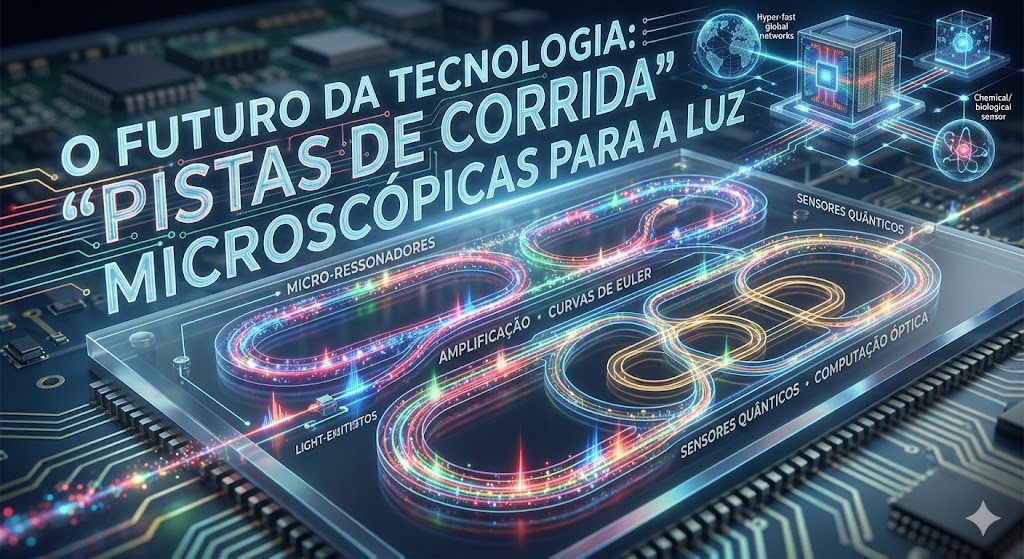
Today, we are going to take a short break from the financial charts to talk about an invention that sounds like science fiction but was just created by researchers at the University of Colorado: they built microscopic racetracks for light.
But what does this mean, and why should you care? Let's translate this without the boring economic or scientific jargon.
How Does the Light "Racetrack" Work?
Imagine a Formula 1 track. If the track has curves that are too tight, the cars have to brake hard, or they end up flying off the track, right?
Scientists faced a similar problem with light. They create tiny microscopic paths (called resonators) for light to circulate and gain strength. The problem is that on the curves of these paths, a lot of light "crashed and leaked," losing energy.
The big breakthrough was using the engineering of our asphalt roads. They redesigned these microscopic tracks with very smooth curves. This way, the light can circulate at high speed without "crashing" and without losing energy. The result? The light stays trapped in there, spinning for much longer and becoming much more intense.
The Magic of Manufacturing and the "Special Glass"
To build this, you can't use normal tools. We are talking about something smaller than the thickness of a human hair!
They used a special glass (called chalcogenide) and machines that draw using electrons instead of light. The level of precision is so absurd that any tiny speck of dust could destroy the entire project. That's why everything was done in ultra-clean rooms.
Why Does This Matter (Even for Your Wallet)?
You might be asking yourself: "Cool, but how does this change my life?"
The answer is: efficiency and innovation. This new way of guiding light uses significantly less energy. In the near future, this technology will be used to create ultra-sensitive sensors (capable of identifying chemicals in the air), improve GPS navigation, and even help build super-powerful quantum computers.
For those who like to invest and usually read our guides like The Reality of Cryptos in Brazil, keeping an eye on this kind of cutting-edge technology is fundamental. The companies that manage to transform these microscopic innovations into real products for the end consumer will be the giants of tomorrow. The future of technology is in the details invisible to the naked eye!
(Legal Notice)
Investments involve risk, and past performance is not a guarantee of future results. We do not make direct recommendations.
ConTATO


Cezar Pimentel
Crypto expert
Editor and writer for Money Bridge.
Contribute to our blog:
Wallet Lightning: knownworm12@walletofsatoshi.com
Chave Pix: 635af7b7-92ab-4b5a-a7d3-541d3fd41701
Bitcoin On-chain: 1D1dbDJiQKuLLcWCH2M2yVjArWj3yCufmn
USDT Polygon: 0xb83948456f41cb8b0f8528472558d7fe977cd4c9
USDT TRC20: TBKMFK9BGudeEsaXwL3z9dnQC8nakFrKAM
USDT BEP20: 0xb83948456f41cb8b0f8528472558d7fe977cd4c9
USDT SOL: 3afEJTg2oDbXf6diL5SUf4g87S13hyWtXcsJxde8XzAn
USDT TON: UQDeeyyGHoXCW18QcNCElonzmntgzeki3rtqqN8zZnNDMtLO
USDT Arbitrum one: 0xb83948456f41cb8b0f8528472558d7fe977cd4c9


Acceptance of Terms – Money Bridge